A field discovery about queen pheromones and queenright cell finishers that most beekeeping resources miss
If your queen cells keep getting destroyed in a queenright finisher, you’ve probably blamed your grafts, the timing, the dearth, or your nurse bee ratio. Most beekeepers do. You may have even tried starting fewer cells, thinking a lighter load would help. It doesn’t. But if you have plenty of nurse bees per cell and you’re still losing cells, there’s a good chance the real problem is something almost nobody talks about: your colony is too small to dilute queen pheromones sufficiently.
In 2025, I figured this out the hard way while grafting from late April through July, roughly 12-14 rounds of troubleshooting, and eventually connecting dots I couldn’t find connected anywhere in the beekeeping literature.
What Happened: ~20 Cells Started, 0-5 Finished
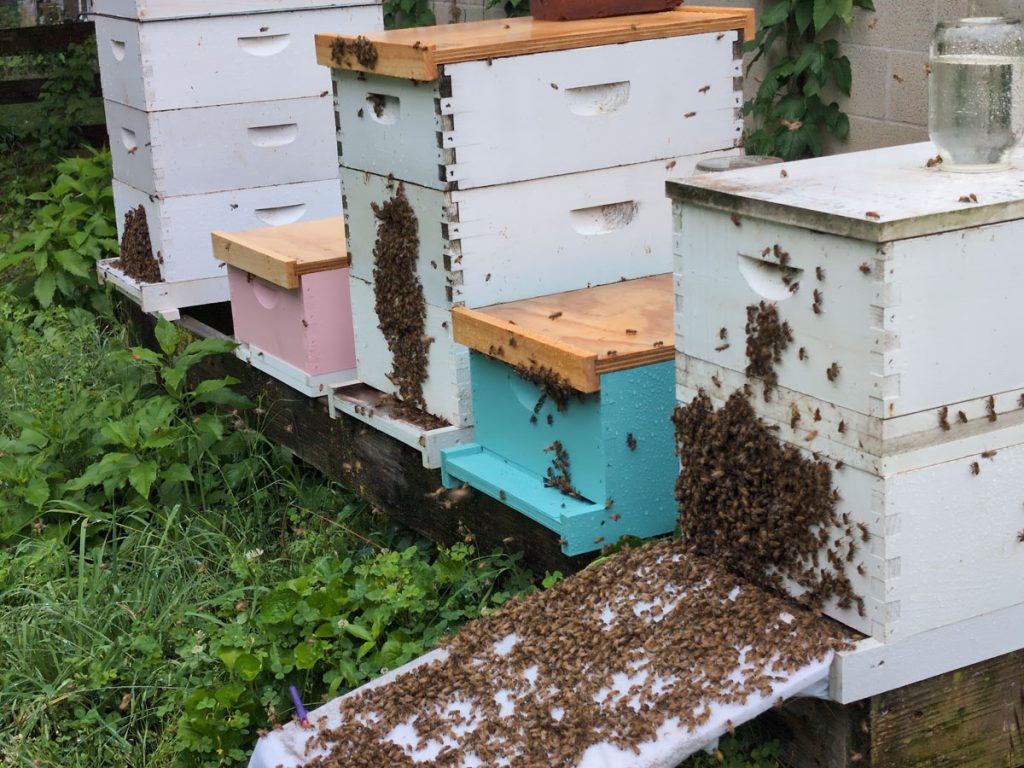
I was using Bob Binnie’s queenright starter/finisher method, which he runs in double deep 10-frame colonies. I wanted to adapt it for my 8-frame medium equipment. My setup, a double 8-frame medium, is roughly half the volume and bee population of a double deep. I figured I’d just start fewer cells and that the system would work great.
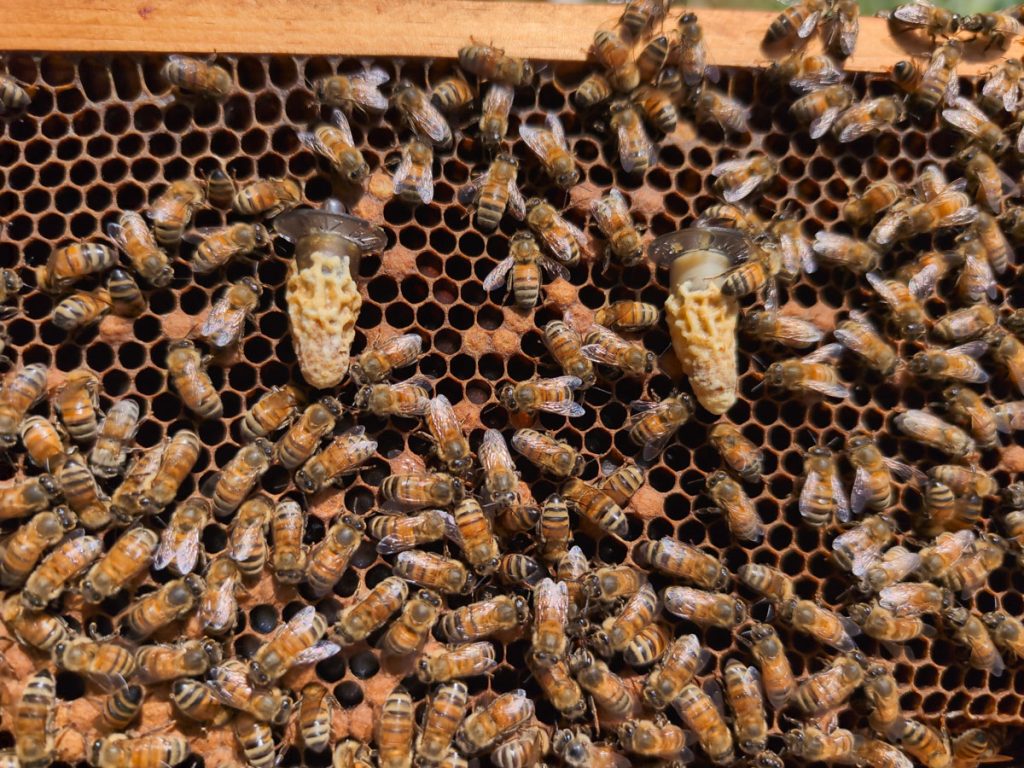
That didn’t work. I started around 20 cells each week and finished 3-5. Sometimes zero. And the cells that did survive were small. Cell starts looked great when I moved them from the starter to the finisher and often were capped, but then torn down.
The puzzling part: I had plenty of nurse bees relative to the number of cells I was trying to finish. By every standard measure, I should have had enough. Something else was going wrong.
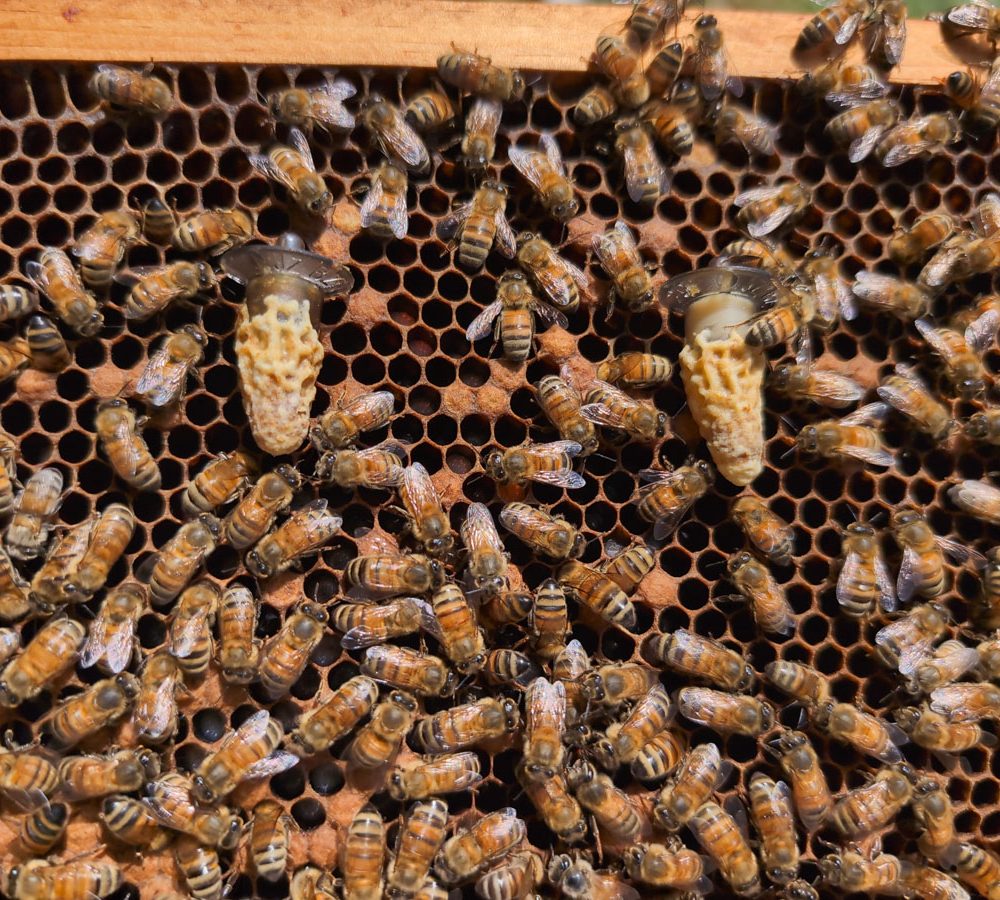
One early round gave me a particularly clear diagnostic: I grafted 16 cells, left the colony queenless for about 18 hours or so, and then made it queenright by sliding the queen below an excluder, timing that falls squarely within the 18-24 hour window often cited as ideal. On harvest day, the cells were gone. The cell bar frame was webbed over with burr comb. Buried in that comb was one JZBZ cup containing a single queen cell that looked much smaller than it should.
The 18-hour window was probably fine. The problem was that my colony, two 8-frame mediums, was too small to suppress QMP in the upper box even with an excluder in place. The bees above the excluder never fully committed to finishing, and when pheromone levels didn’t stay low enough, they abandoned the effort entirely.
Two Variables, Not One
Most queen rearing resources frame the queenright finisher around one variable: nurse bee density. Enough nurse bees means enough royal jelly means good queens. That’s true, but it’s only half the picture.
In a queenright finisher, you actually have two independent variables:
- Queen pheromone dilution determines whether cells get accepted in the first place
- Nurse bee density determines how well cells are provisioned once accepted
Variable #1 must be satisfied before variable #2 even matters. You can have a high density of nurse bees and still lose every cell if the colony isn’t large enough to dilute QMP below the acceptance threshold.
The correct sequence: first ensure total colony population is above the threshold, then optimize for nurse bee density. Dense clustering around the cell zone also helps maintain the tight thermal envelope (around 34-35°C) that developing queen cells require, which is another reason why population matters beyond just nurse bee count.
The Real Reason Queen Cells Get Destroyed: Queen Pheromone Dilution
Queen Mandibular Pheromone, QMP, is the chemical signal the queen uses to tell her colony she’s present and healthy. It spreads primarily through the colony bee-to-bee via trophallaxis (food sharing), antennation (antenna-to-antenna contact), and cuticular touch. Workers pick it up from the queen and pass it along through the colony like a chain.
Here’s what that means for a queenright finisher: the larger the colony, the more bees the pheromone is shared among, and the lower the per-bee concentration across the whole colony. In a large colony, QMP gets diluted across tens of thousands of bees. Each individual bee carries a weaker signal, not because of where they are in the hive, but because the total pheromone load is spread across a much larger population. Think of it like diluting food coloring in water: the color doesn’t disappear at the edges, the whole bucket just gets lighter. Every bee in the colony shares in that diluted signal, including the ones tending your grafted cells.
In a small colony, the same pheromone output from one queen is shared among far fewer bees. Each bee carries a stronger dose. The message is clear: there’s a queen here, we don’t need more queens. And so they tear down your cells.
This isn’t a new concept in bee biology. It’s the same mechanism that triggers swarming. As a colony grows, QMP per bee drops below a threshold and the colony begins building swarm cells. The science is well established. It just hasn’t been clearly connected to the practical problem of queenright cell finishing.
And here’s what makes this especially tricky: queen cell inhibition isn’t a linear scale. It’s a threshold, a cliff, not a slope. Above a certain QMP concentration per bee, cells get torn down. Below it, they get accepted. When I halved my colony size, while I proportionally reduced QMP levels, I nearly eliminated the number of cells that were finished. Cell production fell off the cliff entirely. Plenty of nurse bees per cell, zero results. This is why the standard advice to “use a strong colony” is correct but incomplete. A colony that’s merely good isn’t the same as a colony that’s large enough. There’s a minimum population threshold below which a queenright finisher simply doesn’t work, regardless of how healthy or well-provisioned the colony is. Starting fewer cells won’t help either; the population requirement doesn’t scale down with your cell count.
Unexpected Proof: Queenright Finishers That Swarmed
While troubleshooting, I noticed something odd: a few of my small colonies worked better as finishers than the others. I figured out which ones through trial and error, and then watched them swarm shortly after.
That’s not a coincidence. A colony on the verge of swarming is already pheromone-depleted: the queen’s QMP output is no longer sufficient to suppress swarm behavior across a large population. Those same colonies were below the QMP threshold for suppressing queen cell acceptance too. Both behaviors, good cell finishing and imminent swarming, had the same root cause: low QMP per bee.
I was accidentally selecting for pre-swarm colonies every time I found a small finisher that worked. The success was real, but unstable and unpredictable, and it came with the cost of losing the colony to swarming. Understanding the mechanism helped me build a reliable system instead.
How Big Does a Queenright Finisher Need to Be?
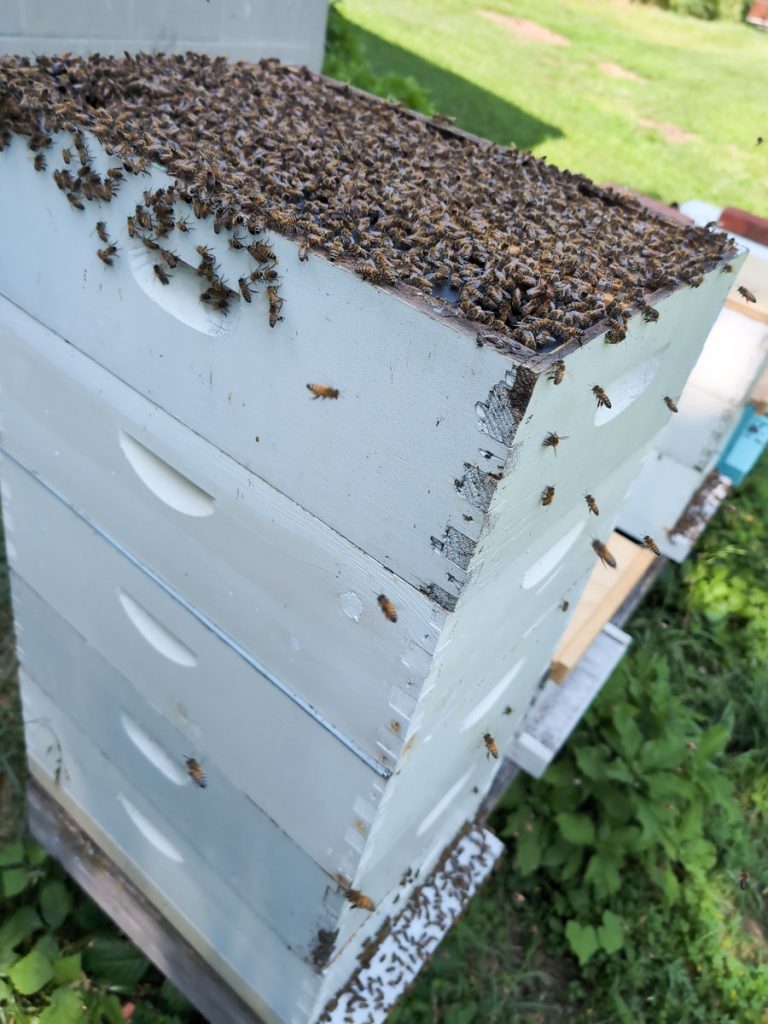
The standard Bob Binnie queenright starter/finisher setup uses 2 x 10-frame deeps, and it works reliably. That colony size appears to be approximately the minimum threshold for consistent cell acceptance in a queenright finisher.
Equipment equivalencies:
- 2 x 10-frame deeps = minimum reliable threshold
- 4 x 8-frame mediums ≈ equivalent volume and population
My finisher colonies now run 5 x 8-frame medium boxes or more, which exceeds the minimum and likely contributes to the 80%+ acceptance rate I now see consistently.
One important clarification: it’s not about distance from the queen. QMP spreads primarily through bee-to-bee contact. What matters is the total number of bees across the entire colony, not how many boxes separate the queen from the cells. A tall colony with sparse population could perform worse than a shorter but densely packed one.
Can You Use 8-Frame Mediums for Queen Rearing? Yes, With the Right Setup
If you’re using 8-frame medium equipment and adapting Binnie’s method, the key is to match the total colony volume, not just replicate the box count. Two 8-frame mediums do not equal two 10-frame deeps
To recreate the Binnie volume in 8-frame mediums:
- Use 2 boxes below the excluder + 2 boxes above (with cells in the top box)
- Or use my approach: a separate dedicated finisher colony of 5+ boxes
The separate finisher approach has a practical advantage: you’re not digging into a massive colony to add cells. You’re just adding your grafted cells to the top box of the finisher, which is low intervention, low disruption, and easy management.
My Current System: From 0-25% to 80%+ Acceptance
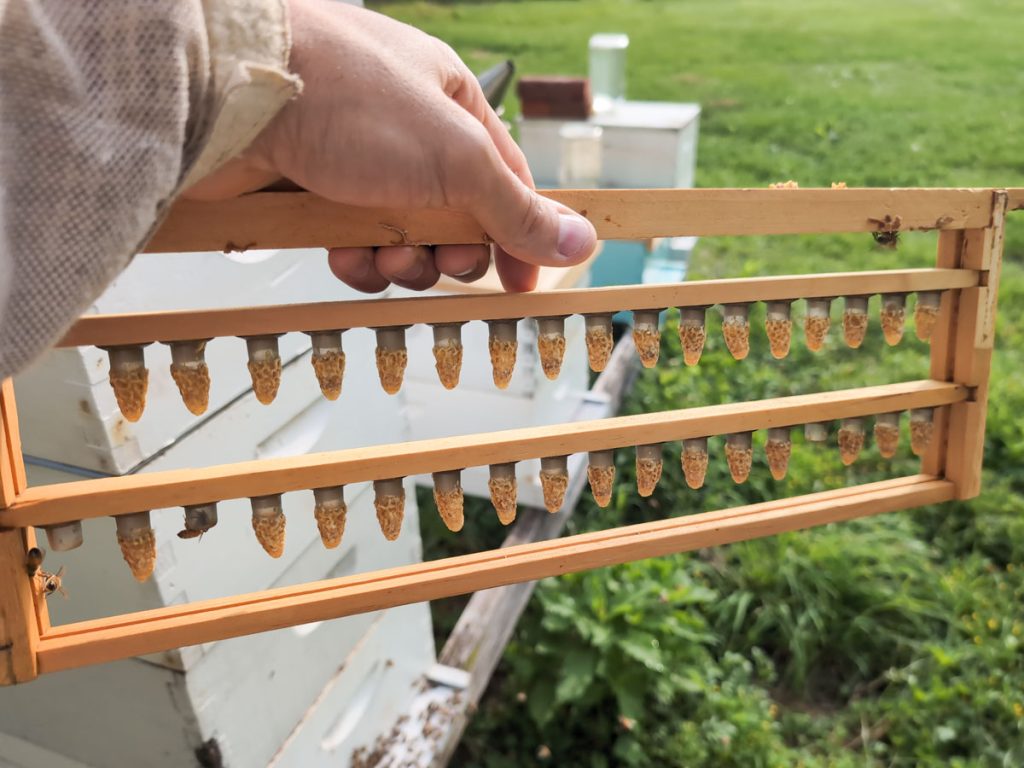
Starter: Double 8-frame medium. The day before grafting, I insert a double screen board between the two boxes, isolating the queen to the bottom box and making the top box queenless. This creates queenless conditions for cell acceptance without weakening the colony. After grafting and allowing 24-48 hours for cells to be started, I remove the double screen board and replace it with a queen excluder, converting the colony back to queenright.
Finisher: 5 x 8-frame medium boxes with a laying queen, queen excluder, then one additional box on top containing the grafted cells, pollen frames, and a feeder.
The purpose of the queen excluder is to prevent the queen from reaching the cell box and destroying the cells herself. A queen’s instinct is to eliminate rival queens, and she’ll tear down queen cells without hesitation. The excluder keeps her below while workers move freely above to tend the cells. Keeping her from laying in the cell box is secondary; keeping her away from the cells entirely is the point.
Cells started in the starter colony are transferred to the large queenright finisher after 36-48 hours, after the cells have had time to be accepted and begin drawing out. This two-stage approach is deliberate: the queenless top box gives cells a strong start, with no pheromone suppression at all. The queenright finisher then provides stable, long-term conditions for the remainder of development. Each environment does what the other can’t.
Result: acceptance rates jumped from 0-25% to consistently above 80%.
What If Your Finisher Still Isn’t Strong Enough?
If you’re running at the minimum threshold (such as double deeps), a queen with a particularly strong pheromone profile can sometimes push a borderline colony over the edge into cell rejection. The fix is to boost the population further. Shake in frames of nurse bees from a strong colony. Open brood frames work best to shake from as they contain a higher percentage of nurse bees. You can also add capped and emerging frames to your finisher each week to keep the population of young bees boosted. Remember: the queen’s pheromones spread primarily through bee-to-bee contact. More bees means more dilution points in that contact chain.
Don’t be tempted to just start fewer cells in a borderline finisher. The threshold effect means a slightly-too-small colony won’t finish 5 cells any better than 20. The population requirement doesn’t scale down with your cell count.
The Downstream Damage: Why Torn-Down Cells Are Only the Beginning
When cells get torn down, the most common response is to pull them immediately after capping and put them in an incubator. It solves the teardown problem but introduces new ones. Freshly capped cells are fragile; the pre-pupa is still feeding briefly before spinning its cocoon, and rough handling can dislodge it. More importantly, an incubator cannot replicate what bees do to capped cells. Workers transmit vibrational signals through the comb that influence queen development, and colony temperature regulation is more precise and responsive than most incubators. Experienced queen rearers consistently report that queens emerging in mating nucs outperform queens emerged in incubators.
Queen quality at emergence also directly affects mating success. A well-provisioned queen from a well-tended cell is larger, heavier, and has more ovarioles, traits that correlate with drone attractiveness, flight capacity, and sperm storage. The research is clear: better cell, better queen, better odds of returning from the mating flight.
If you pulled cells into an incubator early because of teardowns, you got hit twice: poor finishing in the colony and suboptimal development in the incubator. The root cause was colony size, but the consequences rippled all the way to your mating success rates.
You’re Not Alone: The Beesource Thread Graveyard
This problem is not rare. A search of Beesource, turns up dozens of threads from beekeepers describing exactly this experience: cells accepted, cells capped, cells torn down. Fruitless troubleshooting. Workarounds involving incubators. No clear answer.
A few examples:
In one thread titled “Queen Cells being torn down in finisher” (7,000+ views), a beekeeper using a strong double-deep queenright finisher describes losing cells consistently 2-4 days after capping, despite good acceptance and coverage. The community’s best answer: buy an incubator.
In another thread, a beekeeper ‘jonboar’ reports running a queenright method: 19 of 20 cells capped and beautiful at day 7. By day 10, torn down to 6. Next batch, same result. Again, no mechanism identified.
In perhaps the most striking thread, “Bees tearing down queen cells” (8,800+ views, 2020), a beekeeper has tried every variation: starter/finisher, queenright finisher, queenless finisher, Cloake board, shaking in bees until near-swarming conditions. Still loses cells down to 3-6 every time. The community offers suggestions about nurse bee ratios and excluder failures. Nobody mentions total colony population as a QMP dilution problem.
What’s notable is that experienced beekeepers in these threads do understand that queenright finishers need to be strong and populous. This is implicit in every recommendation to use “a very strong hive” or “solid boxes of bees.” But the reason why colony size is the critical variable, that it governs QMP concentration per bee, not just nurse bee availability per cell, is never stated. You can do nearly everything correctly, but if your queenright finisher is not big enough the QMP pheromone will be too high and cells will get torn down or never finished.
If you’ve spent a frustrated season losing cells and couldn’t figure out why, you’re in good company. The frustration is common. The explanation, apparently, was not.
I haven’t seen this explained this way anywhere in the beekeeping literature, though the underlying science is well established in swarm biology. If you want to dig deeper into queen rearing timing and management, my queen rearing calendar includes the ‘Josiah Garber’ Method, a variant of the Binnie approach adapted for 8-frame medium equipment with some changes for my preferences.
FAQ: Queenright Cell Finisher Problems
Why are my queen cells being destroyed in a queenright finisher? Beekeepers commonly blame grafting technique, timing, dearth conditions, nurse bee ratios, or excluder failures. But the most likely cause, especially if you have adequate nurse bees, is that your colony is too small to dilute queen mandibular pheromone (QMP) below the acceptance threshold. Workers receiving a strong QMP signal interpret it as “we already have a queen” and tear down introduced cells.
How big does a queenright finisher need to be? The Bob Binnie method uses 2 x 10-frame deeps, which appears to be approximately the minimum reliable threshold. In 8-frame medium equipment, aim for at least 4 boxes total (roughly equivalent volume). More is better; 5+ boxes gives more margin.
Can I use a small colony as a queenright finisher? Generally no, not reliably. Small colonies concentrate queen pheromone among fewer bees, keeping the per-bee dose above the threshold that suppresses cell acceptance. Occasional success in small colonies is usually a sign the colony is pheromone-depleted and likely approaching a swarm.
Does distance from the queen matter in a queenright finisher? No, not directly. QMP spreads primarily through trophallaxis, antennation, and cuticular contact between workers. What matters is total colony population, not how many boxes separate the queen from the cells.
Why do you use a queen excluder in a queenright finisher? Primarily to prevent the queen from physically destroying the cells. Queens instinctively eliminate rivals, including developing queen cells, and will tear them down given the chance. The excluder keeps her body below while workers pass freely above to tend the cells. Preventing her from laying in the cell box is a secondary benefit, not the main reason.
What’s the difference between a queenless starter and a queenright finisher? A queenless starter has no queen, so there’s no pheromone suppression and cells are started readily, but the queenless state degrades quickly. A queenright finisher maintains a stable colony long-term but requires sufficient population to dilute QMP. Using both in sequence (start queenless, finish queenright) combines the advantages of each.
Leave a Reply